
DNAS Seminar Event
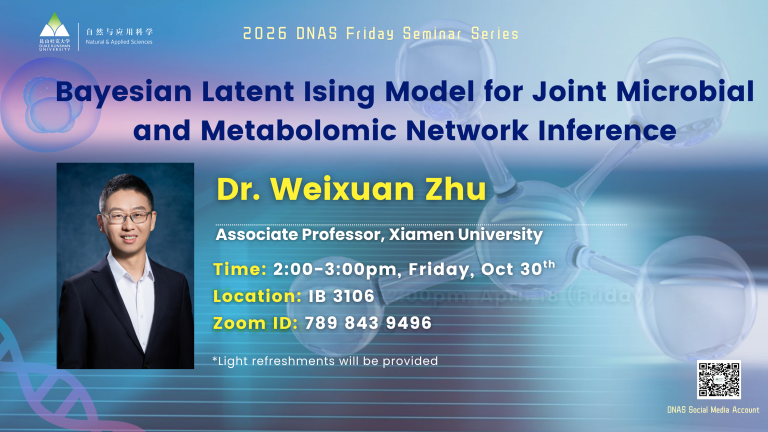
Bayesian Latent Ising Model for Joint Microbial and Metabolomic Network Inference
Date & Time
Date: Friday, Oct 30, 2026
Time: 2:00-3:00 PM
Venue: IB 3106
Speaker

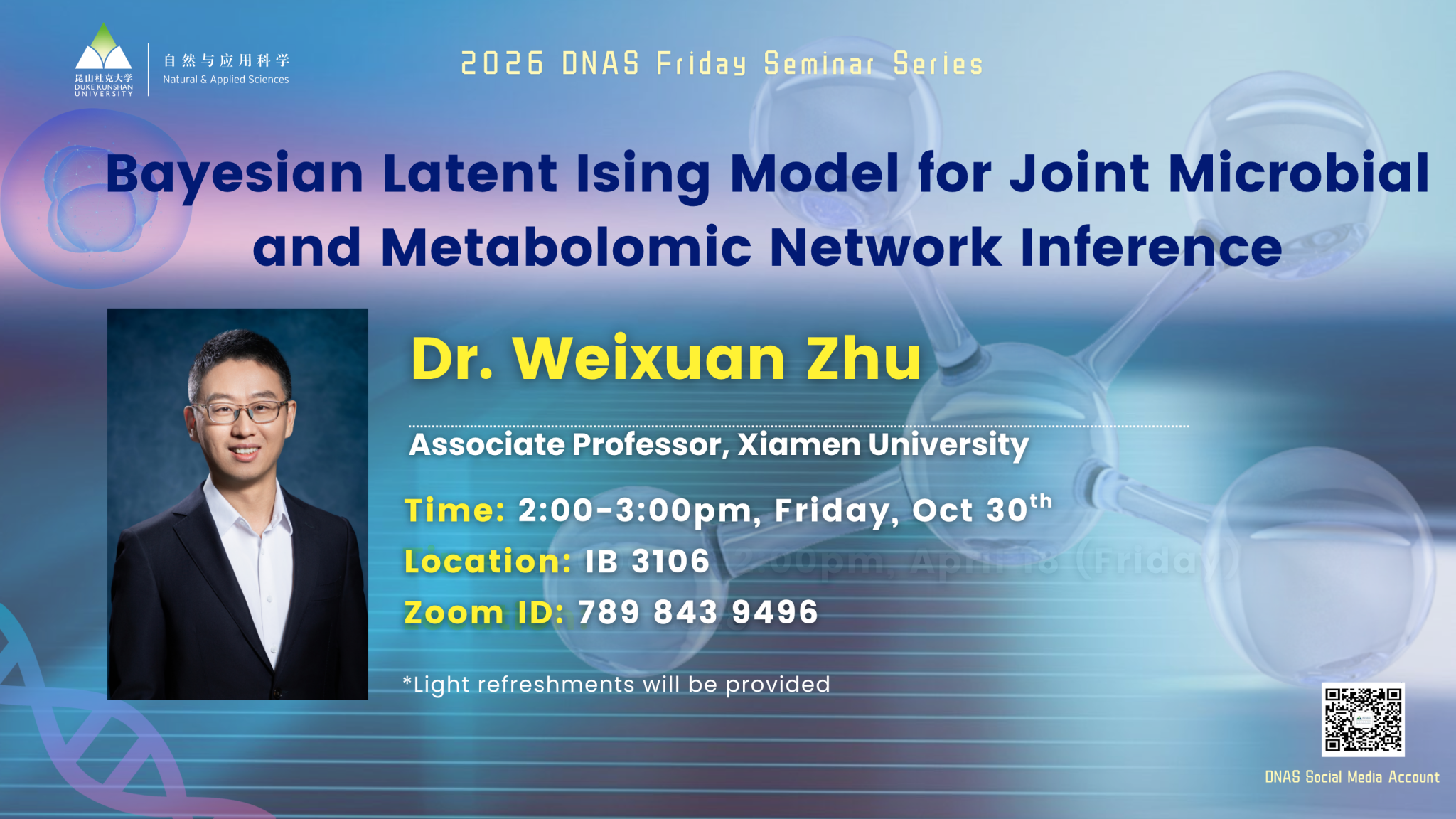
Dr. Weixuan Zhu
Associate Professor, Xiamen University
Abstract
Understanding the complex microbial interactions and their implications for host health is a critical endeavor in biomedical research. In this paper, we propose a transformation-free Bayesian inference approach for estimating microbial and metabolomic association networks based on a latent Ising model. Our method addresses the challenges posed by the compositionality and zero-inflation of microbiome data, offering computational efficiency and versatility for mixed data types. By integrating two-component mixture models tailored to microbiome and metabolome data, along with spike-and-slab priors for sparse graph estimation and a pseudolikelihood approximation for efficient Bayesian computation, we provide a unified framework for joint microbial and metabolomic network inference. Simulation studies demonstrate the superior performance of our method compared to existing approaches, and an application to a real bacterial vaginosis microbiome-metabolome dataset reveals intriguing interaction patterns. Our proposed approach offers a promising avenue for uncovering biological insights from complex microbiome data and holds potential for advancing our understanding of microbiome-associated diseases and therapeutic interventions.
Bio
Weixuan Zhu is an Associate Professor at the Wang Yanan Institute for Studies in Economics (WISE) and the Department of Statistics and Data Science, School of Economics, at Xiamen University. He got his PhD degree from Universidad Carlos III de Madrid, Spain. Before joining Xiamen University, he worked as a Leverhulme Trust Postdoc at the University of Sheffield (UK) in a joint position between the School of Mathematics and Statistics and the Department of Animal and Plant Sciences. He joined Xiamen University in 2017. His primary research interests include Bayesian Nonparametric Statistics, Approximate Bayesian Computation (ABC) algorithms, and Biostatistics.