
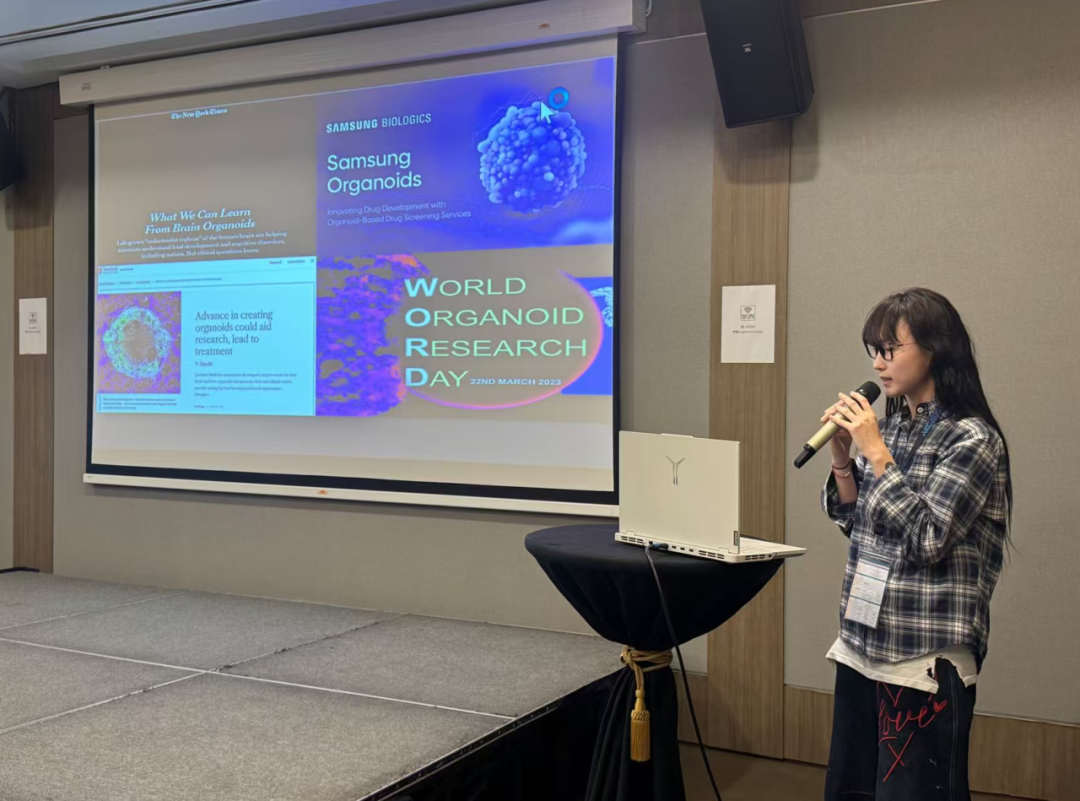
Xinyu Hu presenting her research during a scientific session, delivering a talk related to organoid research and advancements in biomedical science.
Xinyu Hu, an undergraduate student from the Division of Natural and Applied Sciences (DNAS) at Duke Kunshan University, presented her research at the 13th Asia-Korea Conference (AKC2025) held at the NUSS Kent Ridge Guild House, National University of Singapore (NUS), from November 19–21, 2025.
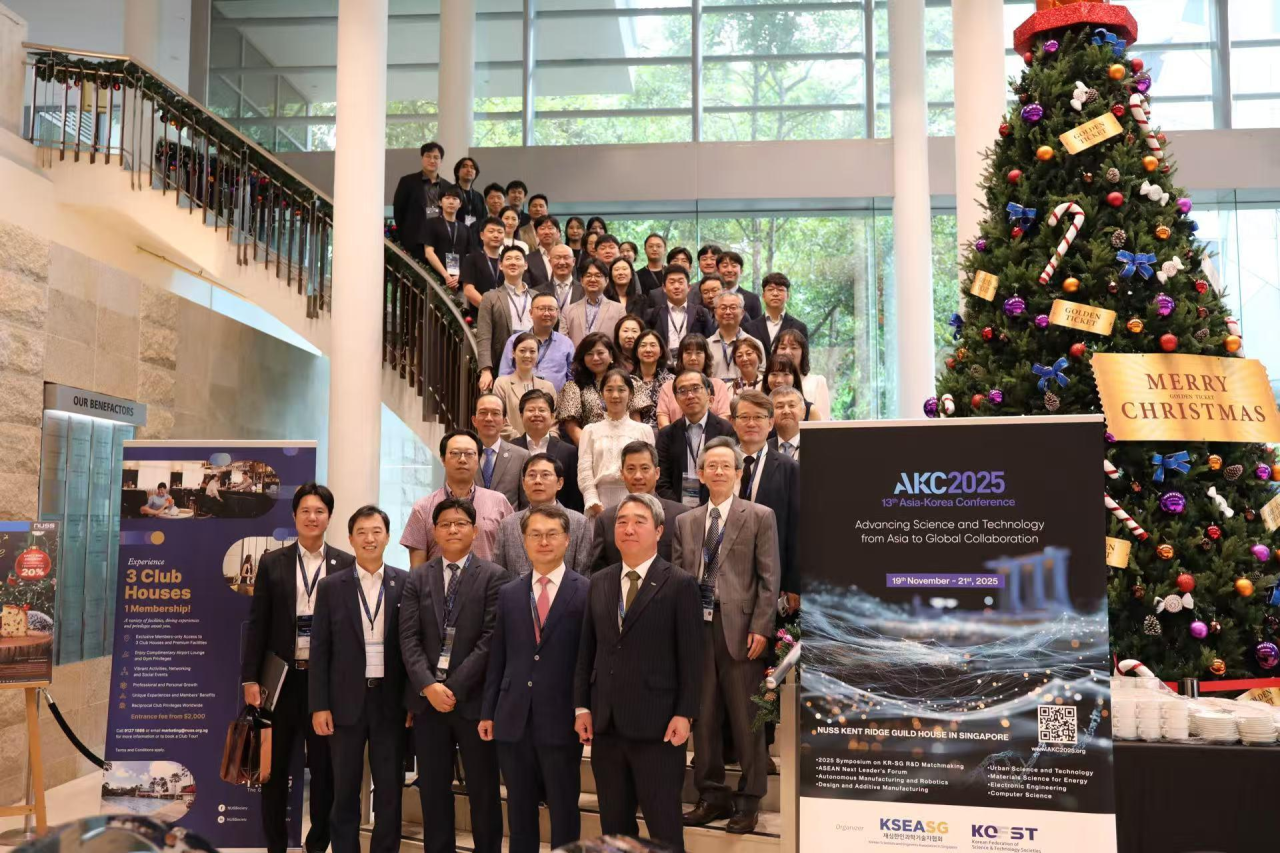
Group photo of all participants at the 13th Asia-Korea Conference (AKC2025) in Singapore, capturing the gathering of researchers and academic leaders across Asia for cross-border collaborative exchange.
The conference, themed “Advancing Science and Technology from Asia to Global Collaboration,” brought together prominent scholars,researchers, and students from across Asia to explore frontiers in science and technology and foster cross-border academic partnerships.
The conference proved to be a vibrant gathering of scientific minds, organized by the Korean Scientists and Engineers Association in Singapore (KSEAS). Featuring sessions spanning diverse fields, from Autonomous Manufacturing and Robotics to Materials Science for Energy and Electronic Engineering, AKC2025 offered a rich platform for interdisciplinary exchange.
Under the guidance of Professor Eunyu Kim, Xinyu gave an oral presentation on the evolutionary divergence of ligand-receptor pairs and how these molecular changes shape intestinal organoid compatibility across species.The research examined how key signaling molecules – ligands and their corresponding receptors – have diverged over the course of evolution, and how this divergence influences the ability to culture intestinal organoids using growth factors derived from different species. By integrating phylogenetic analysis with functional studies in organoid systems, the work offers new insights into the molecular basis of cross-species compatibility in organoid culture, with implications for advancing comparative biology and regenerative medicine.
The event also marked a continued presence of the DKU CReAtE Lab at this prestigious forum. Professor Eunyu Kim, who was previously honored with the “Overseas Scientist of the Year” award accompanied by a presidential commendation at the 12th Asia-Korea Conference in Shanghai, once again championed DKU’s representation alongside her mentee.
In addition, at the 13th AKC, she participated in the Women Scientists Session as a representative female scientist from China, where she delivered remarks on the theme “Women in Science and Technology: Global Inclusion and Leadership.”
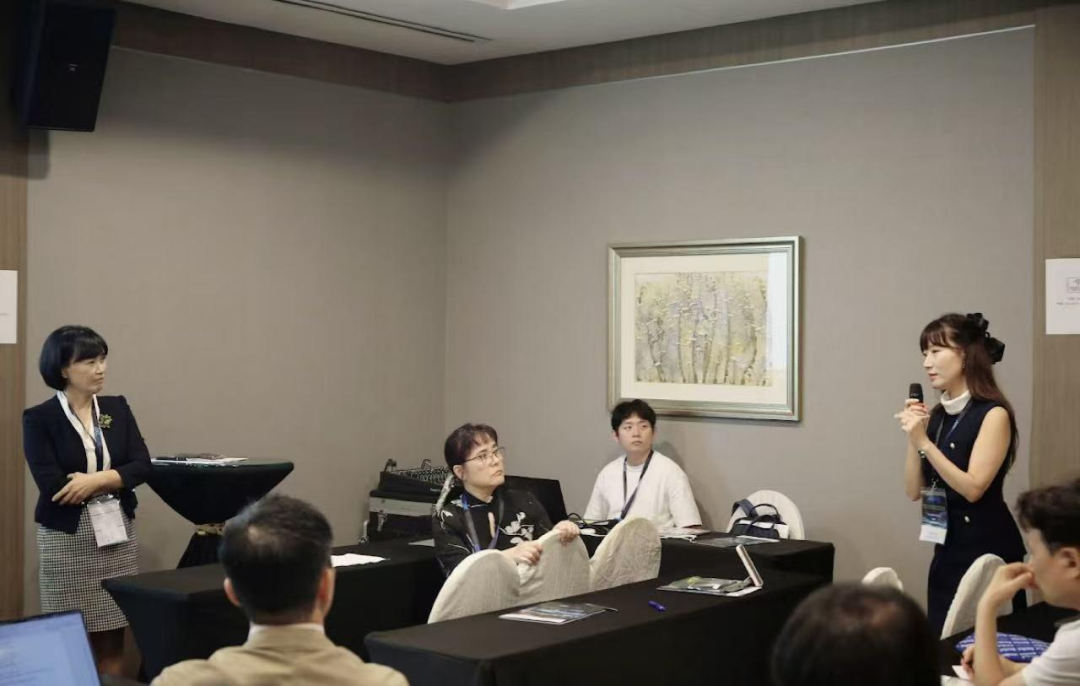
Professor Eunyu Kim delivering remarks during the Women Scientists Session at the 13th Asia-Korea Conference, speaking on women’s leadership and global inclusion in science and technology as a representative from China.
Xinyu had the opportunity to engage with leading researchers and fellow students through networking sessions and panel discussions, gaining valuable feedback and forging connections that transcend national boundaries.
Representing Duke Kunshan University at this esteemed international forum in Singapore was both an honor and an enriching experience. Xinyu remarked, “Presenting my research at AKC2025 gave me the precious opportunity to share our findings on ligand-receptor evolution with a global academic audience. The conversations I had with researchers from diverse backgrounds deepened my understanding of how computational biology and organoid research can intersect to address real-world challenges in regenerative medicine.”
This achievement highlights DKU’s and NS Division’s commitment to fostering undergraduate research excellence and providing students with opportunities to contribute to the global academic community, reflecting the university’s core commitment to “Research and Practice.”