
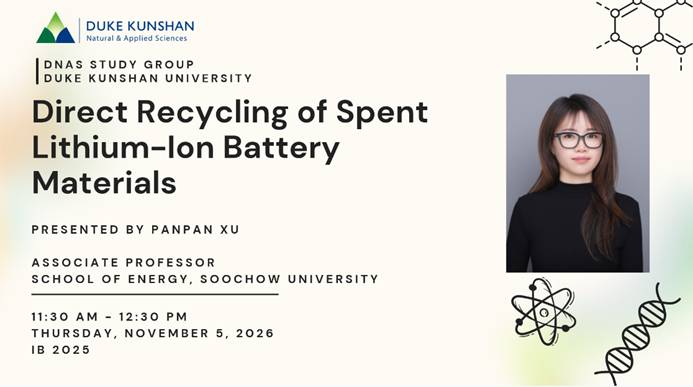
DNAS Study Group
Direct Recycling of Spent Lithium-Ion Battery Materials
Date & Time
Date: Thursday, Nov 05, 2026
Time: 11:30 AM – 12:30 PM
Venue: IB 2025
Speaker

Dr. Panpan Xu
ASSOCIATE PROFESSOR
SCHOOL OF ENERGY, SOOCHOW UNIVERSITY
Abstract:
Panpan Xu is currently an Associate Professor in the School of Energy at Soochow University. Her research focuses on the degradation mechanisms of energy storage materials and advanced recycling technologies. She has published over 60 academic papers, with more than 4,000 citations and an h-index of 31. Over 30 of these papers were published as first or corresponding author in journals including Nature Communications, Joule, Angewandte Chemie International Edition, and Science Bulletin, with three recognized as ESI Highly Cited Papers.
She has been selected for the Gusu Innovation and Entrepreneurship Leading Talent Program and the Jiangsu Innovation and Entrepreneurship Talent Program, and is a member of the Youth Innovation Promotion Association of the Chinese Academy of Sciences. She was recognized as a Nanoscale Emerging Investigator in 2025 and a Journal of Materials Chemistry A Emerging Investigator in 2026. She has led eight research projects, including projects funded by the National Key R&D Program for Strengthening Basic Research, the National Natural Science Foundation of China General Program, and the Jiangsu Provincial Outstanding Young Scientists Program.
Bio
Direct regeneration of spent lithium-ion battery cathode materials is an important approach for achieving high-value recycling. Compared with the conventional long-process route involving metal recovery followed by material re-synthesis, short-process regeneration offers several advantages, including a shorter process flow, lower energy consumption, and greater potential for industrial application. In recent years, this strategy has shown promising prospects for both ternary cathode materials and lithium iron phosphate materials. However, significant differences remain in the degradation behaviors and regeneration mechanisms of different material systems. This report will mainly focus on the repair of lithium-vacancy defects in spent cathode materials, with particular emphasis on the mechanisms of liquid-phase relithiation in the regeneration of ternary and lithium iron phosphate cathodes, as well as the key challenges involved. In addition, from the perspective of industrial application, the report will further discuss the challenges faced by liquid-phase relithiation in terms of cost control, process scale-up, and consistency regulation.