
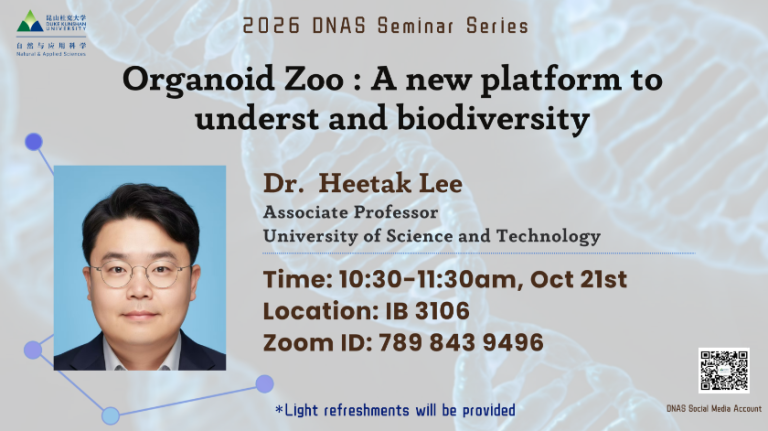
DNAS Seminar Event
Organoid zoo : A new platform to understand biodiversity
Date & Time
Date: Wednesday, Oct 21, 2026
Time: 10:30-11:30 AM
Venue: IB 3106
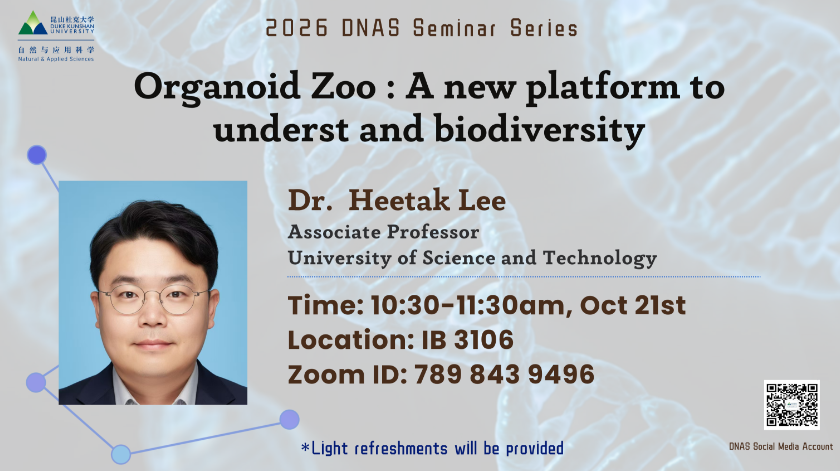
Speaker
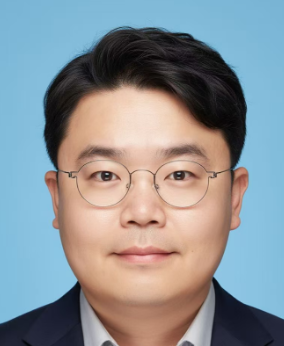
Dr. Heetak Lee
Institute for Basic Science, Research Fellow
University of Science and Technology, Associate Professor
Abstract
Organoids provide a unique experimental framework to connect fundamental biology, disease modeling, and translational research. In this presentation, I will introduce our efforts to build a cross-species “Organoid Zoo” as a comparative platform for studying conserved and species-specific epithelial programs. I will then discuss the REDESIGN project, in which patient-derived gastric cancer organoids are used to dissect intratumoral heterogeneity, clonal evolution, and differential responses to FLOT chemotherapy. These studies are complemented by our work published in Molecular Cancer, revealing context-dependent oncogenic signaling in gastric cancer, and in Nucleic Acids Research, establishing versatile genome-engineering platforms across in vivo models, organoids, and iPSCs. Together, these projects illustrate how organoid-based systems can integrate biodiversity, cancer evolution, genome engineering, and precision medicine within a unified experimental framework.
Bio
Dr. Heetak Lee leads a bioinformatics research group at the Institute for Basic Science (IBS), Korea, where his research integrates organoid biology, cancer genomics, genome engineering, and comparative biology. His work focuses on understanding how intrinsic cellular programs, oncogenic signaling, and tissue environments shape cellular diversity and disease evolution. He has developed multidisciplinary research platforms spanning patient-derived cancer organoids, genetically engineered models, single-cell and spatial omics, and cross-species organoid systems. He currently leads several collaborative projects, including REDESIGN for dissecting intratumoral heterogeneity and therapeutic response, and the Organoid Zoo initiative for comparative studies across diverse species. Through extensive domestic and international collaborations, his research aims to connect biodiversity, disease mechanisms, and precision medicine.