
Date & Time
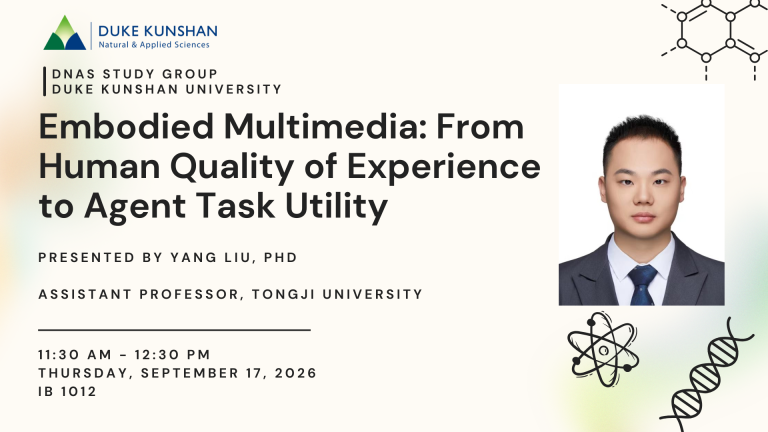
Date: Thursday, Sep 17, 2026
Time: 11:30 AM – 12:30 PM
Venue: IB 1012
Speaker

Dr. Yang Liu
Assistant Professor, Tongji University
Abstract:
For four decades, multimedia systems have been built on a single premise: the consumer is a human observer. That premise is written into every layer of the stack — quantization tables derived from contrast sensitivity functions, distortion metrics validated against mean opinion scores, rate adaptation tuned for perceived smoothness. As AI moves from digital space into the physical world, the consumer is increasingly an embodied agent that must estimate state, decide, and act in a closed loop. The premise no longer holds. This talk argues that the resulting failures are structural rather than incremental. Casting both paradigms as constrained optimization problems shows that minimizing human-perceptual distortion and minimizing task risk are neither equivalent nor monotonically related — high-frequency detail discarded as imperceptible is often exactly what downstream perception depends on. I will introduce Embodied Multimedia, a paradigm that treats multimodal data as the bridge from perception to action, and present a four-layer architecture — Data, Communication, Cognition, and Evaluation — connected by cross-layer feedback.
Bio:
Yang Liu is an Assistant Professor with Tongji University, where he leads the Embodied Perception and Intelligent Computing Laboratory. He received his Ph.D. through a joint program between Fudan University and the University of Toronto, and his B.Eng. from Nanjing University. His research focuses on embodied multimedia computing, with over twenty first- or corresponding-author papers in top-tier venues and more than 3,000 citations. He serves as an Associate Editor of Pattern Recognition and as a Guest Editor for special issues on embodied multimedia in IEEE TCSS and ACM TOMM, and has organized several workshops and special sessions on the topic at IEEE ICME and IEEE ICASSP.