
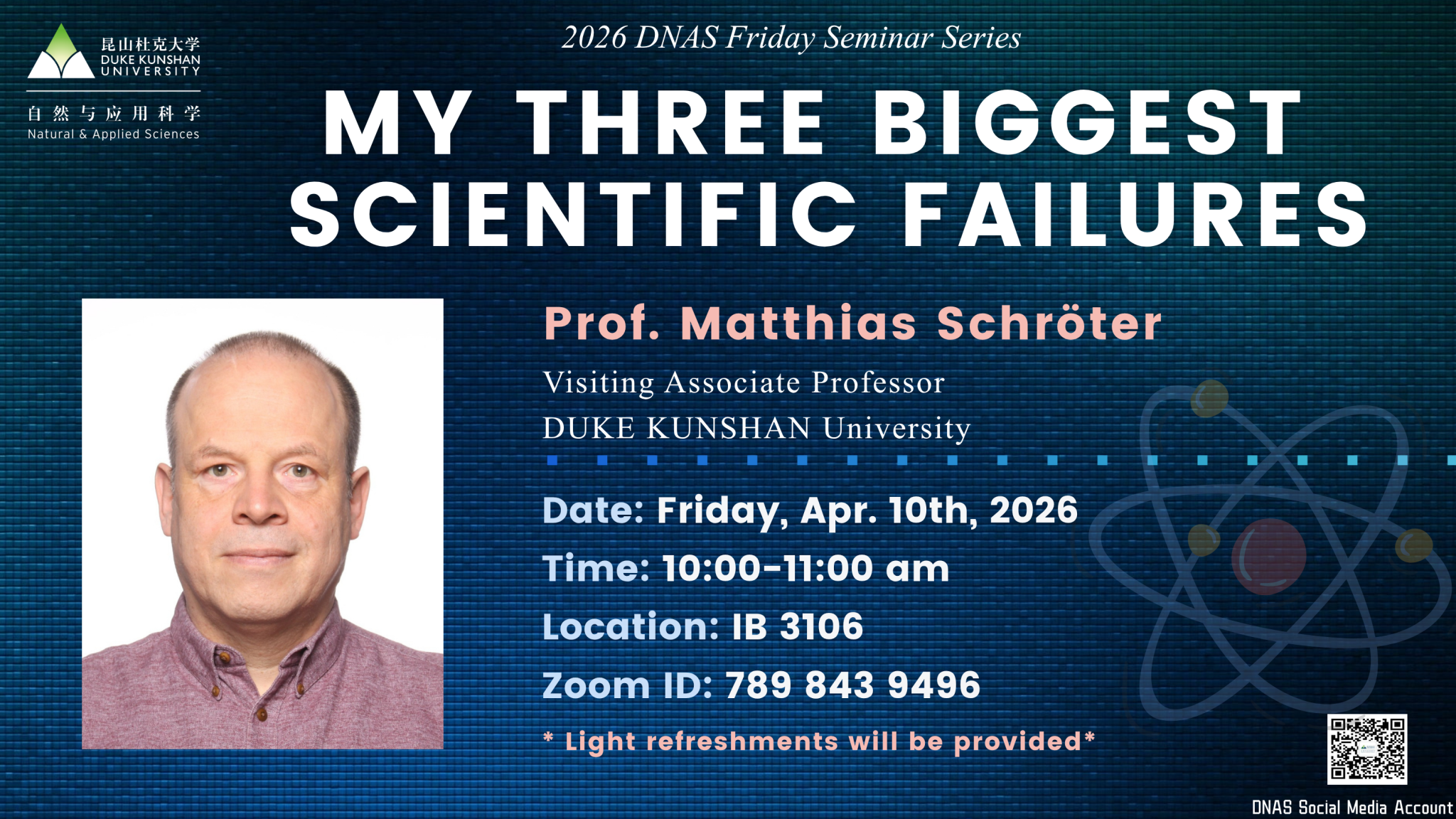
DNAS Friday Seminar Series
My three biggest scientific failures
Date & Time
Date: Friday, Apr 10, 2026
Time: 10:00-11:00 AM
Venue: IB 3106 & zoom: 789 843 9496
Speaker
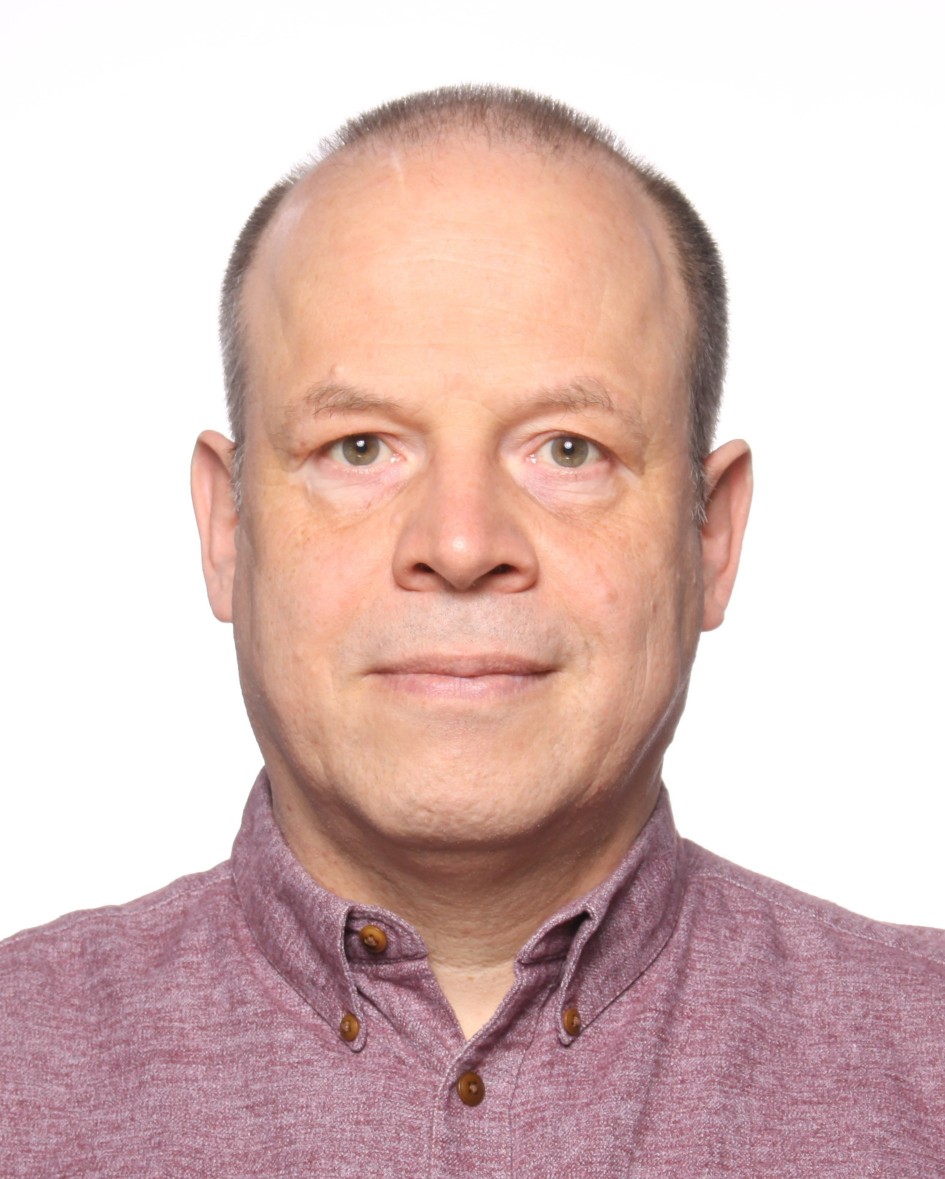
Prof. Matthias Schröter
Visiting Associate Professor, DUKE KUNSHAN University
Abstract
Physics classes often present the evolution of our present knowledge as a series of great experimental and intellectual successes. An example are the extraordinarily precise astronomical measurements of Tycho Brahe which allowed Johannes Kepler to deduce the laws of planetary motion. Any scientific conference is full of presentations that tell, at least in the mind of the presenter, similarly exciting success stories. Students entering a lab will however often experience a very different story: experiments don’t work or provide non-conclusive results, competing theories can only explain different parts of observations, repeated experiments result in quite different outcomes ….. This is normal scientific everyday life: pushing the boundaries of human knowledge will also result in problems, errors of judgement, and failure. But senior scientist rarely talk about their failures. Therefore, beginning scientists often erroneously assume that their own problems in an otherwise apparently so smoothly progressing field must be their personal fault.
This talk will try to paint a more realistic picture about the progress of science by explaining three ideas and setups that did ultimately not work out. And show what lessons can be learned from that. Fortunately, no students were permanently harmed in the process. The talk will be accessible to any DNAS student, not just physics students..
Bio
Dr. Matthias Schröter obtained his PhD in 2003 from the University of Magdeburg for experimental studies on pattern formation. Around the same time, this field fell out of fashion when it became clear that the much more interesting biological patterns had little to do with physics. During his postdoctoral stay with Harry Swinney at the Center for Nonlinear Dynamics at the University of Austin his research focused on granular materials (aka playing with sand) and the question if and how they can be described with a statistical mechanics approach. Between 2008 and 2025 he joined the MPI for Dynamics and Self-Organization in Göttingen, since 2014 he is an associated researcher at the University Göttingen. His main research topics besides granular media are X-ray tomography of complex materials, and applications of machine learning in physics.